

Intelligent Submetering: The Revenue Strategy Most NYC Co-op Boards Haven't Heard Of Yet
Your building is paying retail for energy it could be buying wholesale
(TL;DR)
Most NYC co-op and condo buildings are paying Con Edison's highest retail rates for electricity while handing over roughly $25 per unit per month just in billing fees. Intelligent Submetering, paired with rooftop community solar, lets your building buy electricity in bulk at lower commercial rates, capture solar credits directly to a single master meter, and retain the billing fee savings as recurring revenue. In a recent Urbanstrong project for a Riverdale co-op, the combined strategy projected over $42,000 in annual net revenue with a sub-four-year payback and a 29% IRR. If you want to know what the numbers look like for your building, let's talk.
Table of Contents Show
Your building is spending tens of thousands of dollars a year on electricity. That's not news to any co-op board member or property manager in New York City. What might be news is that a meaningful portion of that money doesn't have to leave the building at all.
Right now, Con Edison is charging every unit in your building roughly $25 a month just to read the meter. Your building has zero visibility into how any of that energy is actually being consumed. And on top of that, every unit is paying Con Edison's highest retail rate for electricity the building could be purchasing in bulk for significantly less.
That's not an energy problem. That's a strategy problem.
There's a technology changing that, and most NYC building owners haven't heard of it yet. It's called Intelligent Submetering, and it's helping co-ops and condos across the city turn their electrical infrastructure from a cost center into a recurring revenue stream. When paired with rooftop solar, it also ensures that every credit your array generates is captured and retained by the building, not lost to Con Edison's administrative fees or stranded across dozens of individual accounts.
This is the first in a series of posts where we'll break down everything NYC co-op, condo, and multifamily building owners and property managers need to know about Intelligent Submetering: what it is, how it works, what it costs, and why the buildings that adopt it first will have a significant financial advantage over those that don't.
What Is Submetering, and Why Should NYC Building Owners Care?
If the word "submetering" triggers memories of 1970s landlords shifting electricity costs onto tenants with opaque billing and dumb analog meters, we understand. That version of submetering earned its reputation.
Forget what you think you know about submetering (I never thought I’d utter the line, “This isn’t your grandmother’s submetering”, so I won’t). What we're talking about is categorically different, and the buildings that figure that out first are going to have a significant financial advantage over those that don't.
Intelligent Submetering vs. the Meters You Remember
Intelligent Submetering is an AI-enabled, software-driven energy management platform that replaces the once-a-month manual meter read with continuous, real-time monitoring of electricity consumption across every unit in your building. It gives building owners, managers, and residents complete transparency into how energy is being used, when it's being used, and what it costs.
Beyond monitoring, the platform can actively manage and schedule energy consumption to reduce costly demand charges, and even enable the building to earn revenue through voluntary demand response participation.
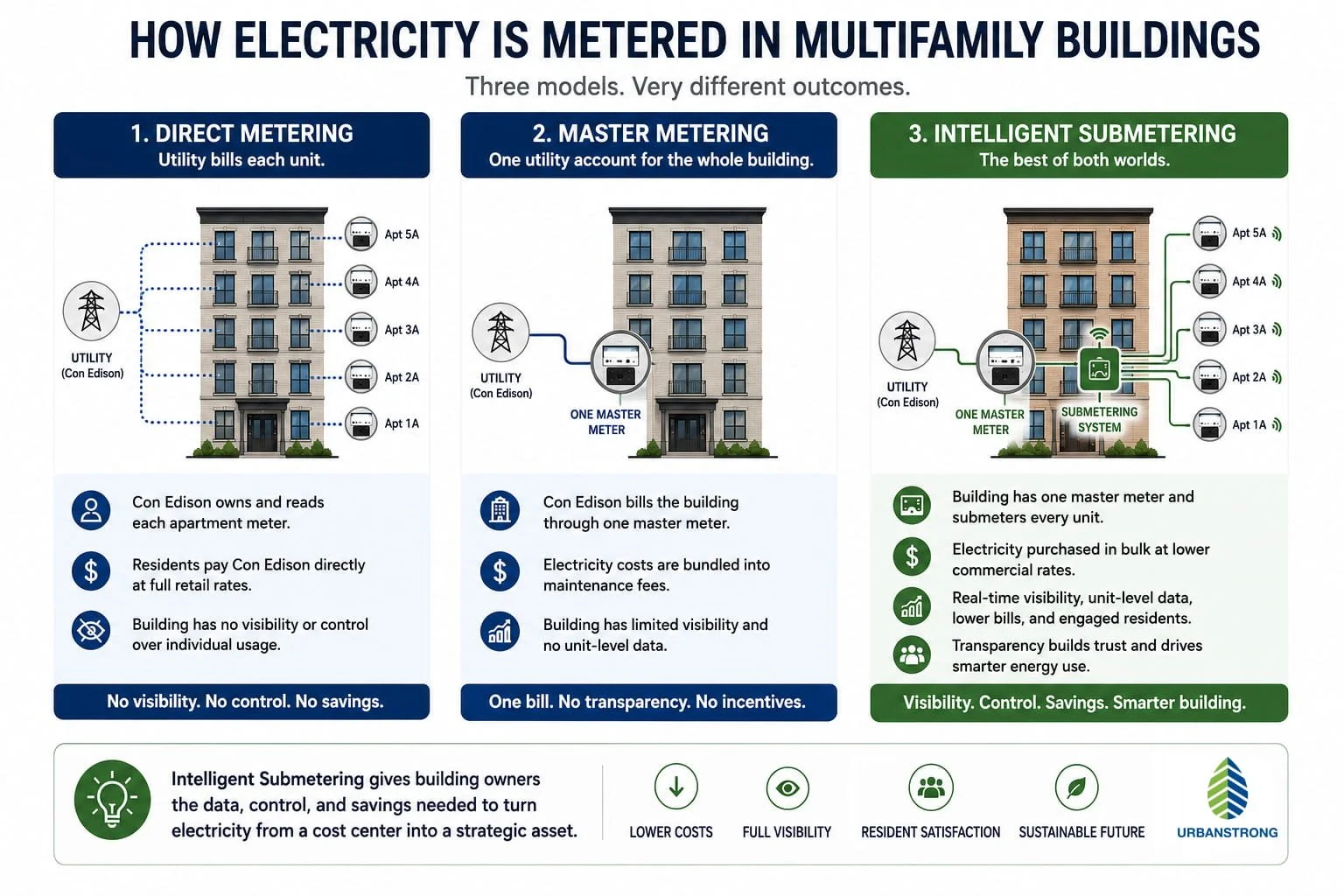
Direct metering vs. master metering vs. Intelligent Submetering in NYC co-op and multifamily buildings.
Residents are fully protected under New York State regulations, and in most cases end up paying LESS than they were before. I'll explain exactly how in the next section.
How Does Submetering Work in a Multifamily Building?
Most NYC co-op and condo buildings operate under one of two models. In a direct metering arrangement, Con Edison owns each apartment's individual meter and bills every unit separately. In a traditional master metering arrangement, the building has a single utility account and one bill for the entire property, with electricity costs typically bundled into maintenance charges rather than billed individually.
Intelligent Submetering introduces a third model, and it combines the best of both.
The building installs one master meter and purchases electricity from Con Edison in bulk at commercial rates, which are significantly lower than the residential retail rates each individual unit was paying. Individual submeters are installed on each unit to measure actual consumption. Residents are billed based on what they actually use: fairly, transparently, and at no more than the rate they were already paying Con Edison.
The building, in effect, becomes the manager of its own energy ecosystem.
This is not a cost-shifting exercise. Residents in a submetered building are protected by the New York Public Service Commission (NYPSC) under strict regulations: they can never be billed more than what Con Edison would have charged them directly. That's the ceiling. The floor is significantly better. Because the building is now purchasing electricity at lower bulk rates, the board typically sees 15 to 20 percent savings on the cost of electricity. How those savings reach residents is up to the board: passed through directly as lower electric bills, applied to the operating budget to reduce monthly maintenance fees or assessments, or a combination of both. Either way, the money stays with the shareholders.
Why One Master Meter Replaces 80 Con Edison Accounts
Under direct metering, your 88-unit building is 88 separate Con Edison customers. Eighty-eight separate accounts. Eighty-eight separate billing relationships. Zero collective purchasing power. Zero visibility into building-wide consumption patterns. And Con Edison is collecting roughly $25 per month per unit in billing and meter-reading fees alone, before a single kilowatt-hour is even consumed."
Under Intelligent Submetering, your building is one sophisticated energy customer with complete data across every unit, bulk purchasing leverage, and the ability to capture revenue from infrastructure you already own. That's a fundamentally different financial position.
What NYC Local Law 97 Means for Your Building's Energy Strategy
If your building is over 25,000 square feet, you're almost certainly subject to Local Law 97, New York City's landmark emissions law that places carbon caps on covered buildings with penalties for non-compliance. The first compliance period is already underway, and the emissions limits only tighten from here.
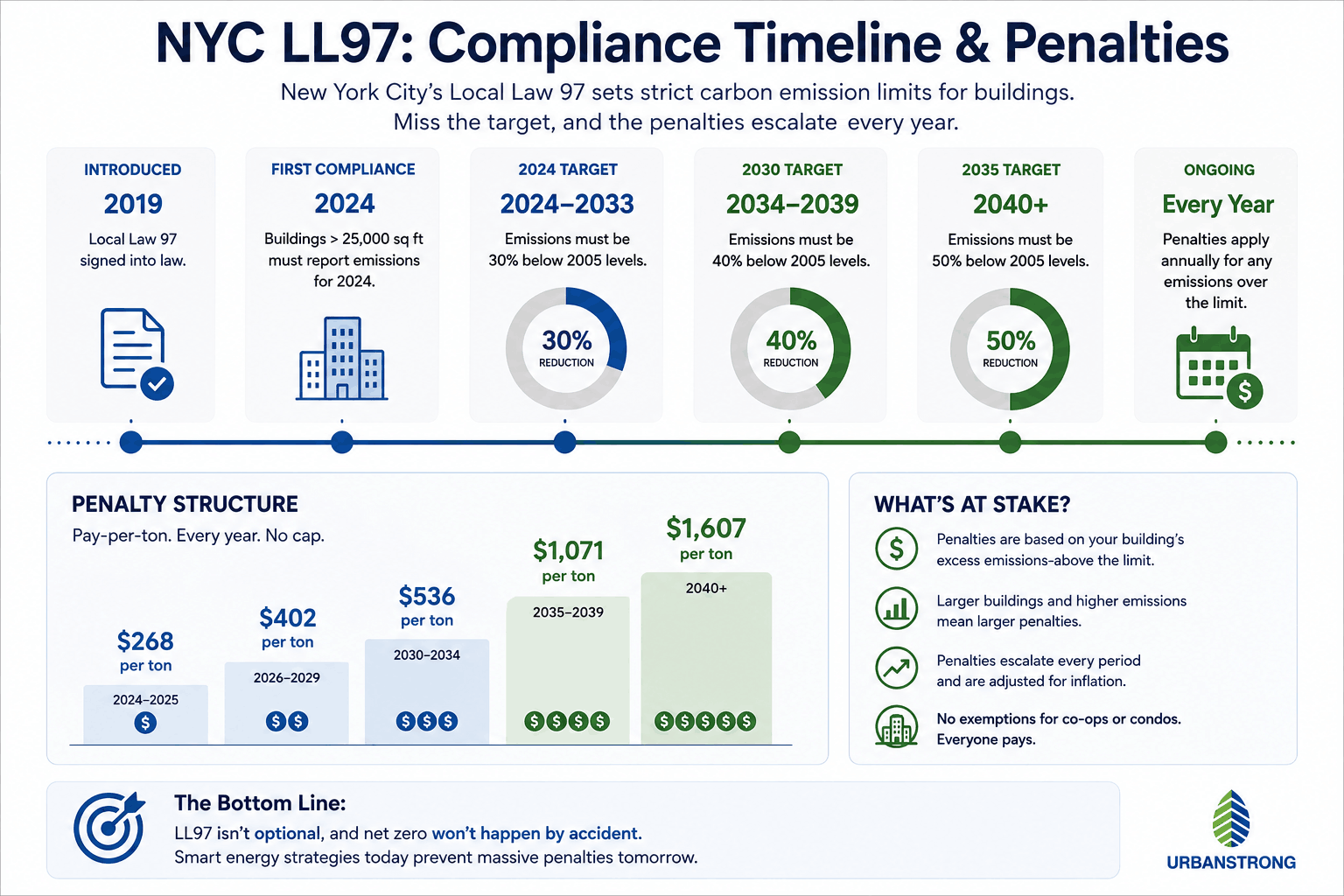
NYC Local Law 97 (LL97) compliance deadlines, emissions reduction targets, and annual carbon penalties for buildings.
At the same time, Con Edison rates continue to rise. Local Laws 88, 92, and 94 are creating additional rooftop obligations, including requirements for sustainable roofing and solar-ready zones on new construction and major renovations.
Here's the critical insight: the compliance pressure and the revenue opportunity are pointing at the same solution. Buildings that invest in Intelligent Submetering and rooftop solar aren't just getting ahead of LL97 penalties. They're building a foundation for long-term energy management, reduced emissions, electrification readiness, and new income streams. The buildings that treat compliance as a cost will fall behind. The buildings that treat it as a catalyst will pull ahead.
Why Solar and Submetering Have to Go Together in New York
The New York State Public Service Commission requires on-site energy generation, such as rooftop solar, as a prerequisite for converting a directly metered building to a master meter with submetering. You cannot do one without the other.
This isn't a limitation. It's a feature. The requirement to pair solar with a master metering conversion is precisely what makes the combined financial case so compelling. And the sun, the resource you need to make it work, is already there, pounding down on your roof every day for free. So why not put it to work for you? The alternative is business as usual, letting Con Edison continue managing all your meters on their terms.
But here's the thing: the sun doesn't send an invoice.
Con Edison does.
Choose wisely.
How Community Solar Credits Work for NYC Co-ops
One of the most common misconceptions about rooftop solar is that your panels are directly powering your building in real time, like a generator on the roof. That's not how it works in New York under the Community Solar program structure.
Under New York's Community Solar Program, the electricity your rooftop array produces is exported directly to the Con Edison grid. Con Edison receives it, distributes it to subscribers or wherever the grid needs it, and in return issues your building bill credits. These credits are calculated using a rate called the VDER Value Stack, which accounts for when and where your energy was delivered, its environmental value, and other factors.
Think of it less like powering your own building and more like depositing money into a bank account. You're not spending it the moment you earn it, but it's yours, and it shows up on your bill.
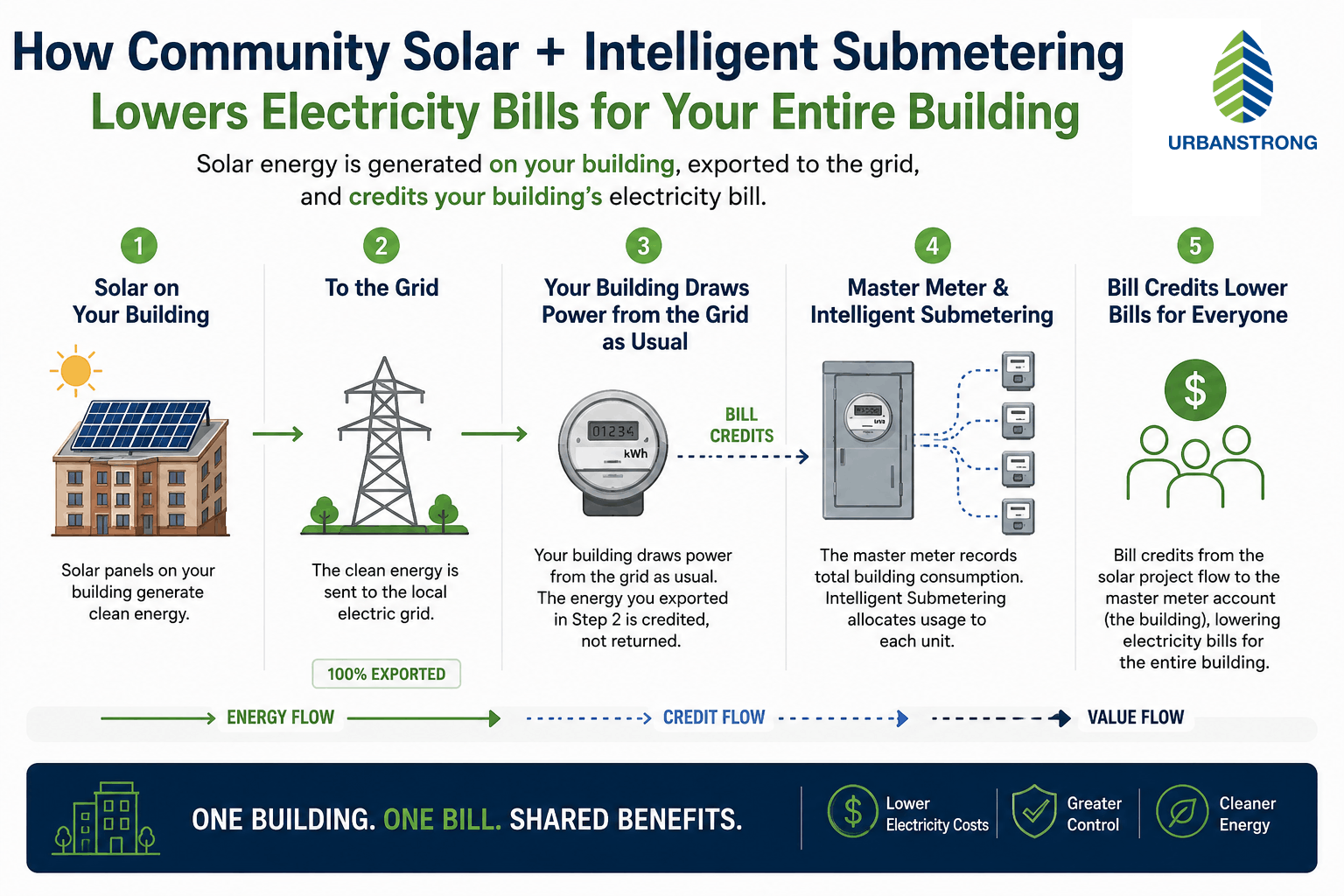
Community solar exports electricity to the grid while bill credits flow back to the building through master metering and Intelligent Submetering.
Those credits flow directly to your master meter account. Under New York State rules published by NYSERDA, master metered multifamily buildings with at least 10 residential units are exempt from the standard community solar subscriber requirements, meaning 100% of your array's credits can be allocated to your single master meter account, rather than being split across multiple subscribers.
That's a significant structural advantage, and one most building owners don't know exists.
From Lids to Buckets: How Roofs Become Revenue Assets
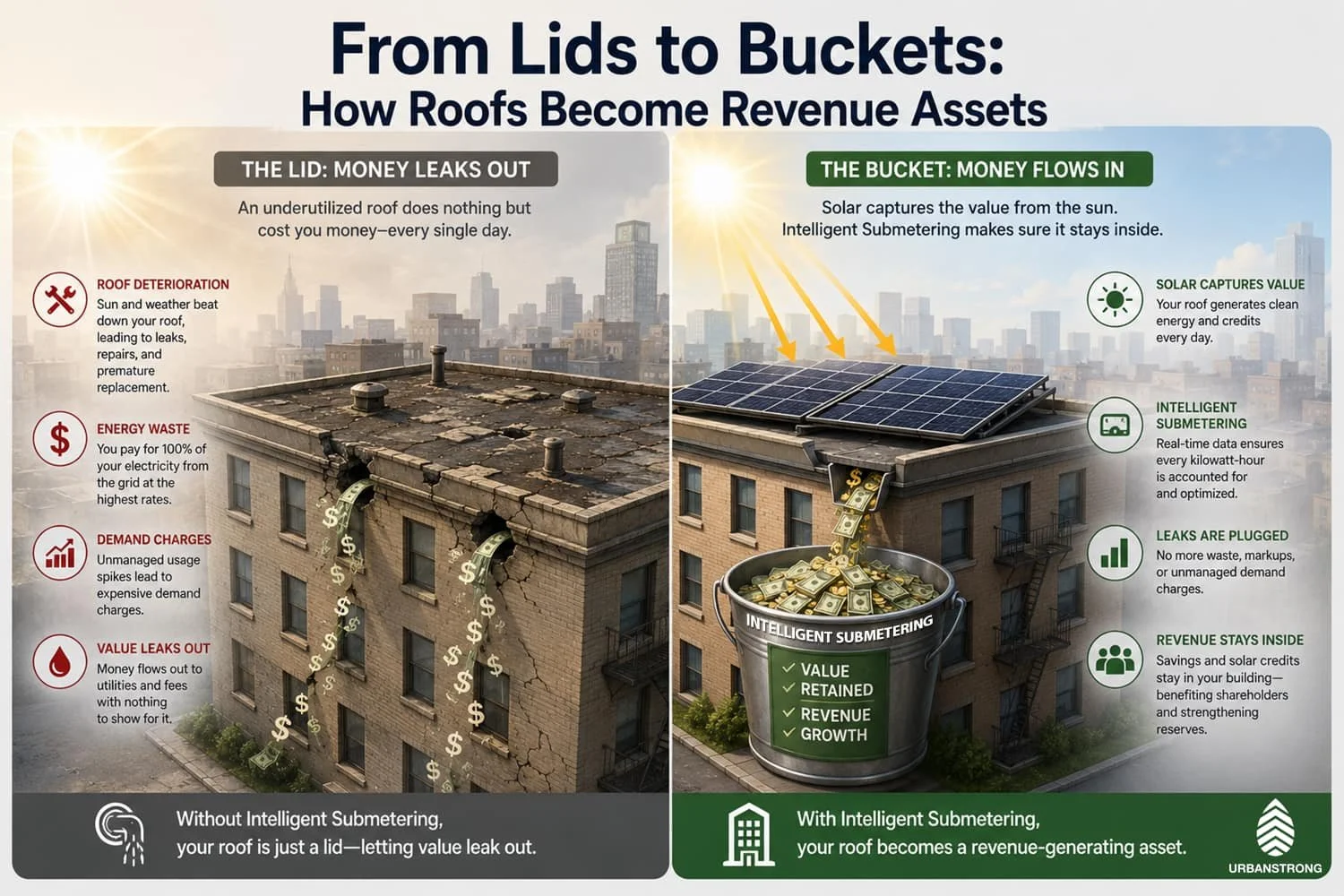
Most building owners see their roof as a lid. The only thing it does is keep the weather out. And inevitably it incurs costs for leak repairs or replacements. At Urbanstrong, we help building owners see their roof as a bucket, one that captures value falling out of the sky every single day.
“Solar fills the bucket. Intelligent Submetering makes sure nothing leaks out.”
Without Intelligent Submetering, the value your solar array generates can leak in multiple directions: to Con Edison's administrative fees, to retail-rate markups your residents shouldn't be paying, to unmanaged demand charges that spike your bill during peak hours. With Intelligent Submetering, every one of those leaks is plugged, and the revenue stays inside your building's financial ecosystem where it belongs.

Buildings with undeveloped, traditional roofs leak money. Rooftop solar paired with Intelligent Submetering helps NYC co-op and multifamily buildings capture recurring energy revenue instead.
How a Roof Replacement Can Qualify for Solar Incentives
If your building is facing an inevitable roof replacement, timing it alongside a solar and Intelligent Submetering conversion can significantly reduce your out-of-pocket cost. When the roof is part of the solar project scope, a portion of the roof cost becomes eligible for incentives that would never apply to a standalone roof job, including NYSERDA grants and the NYC Property Tax Abatement, which returns 30% of qualifying project costs as a reduction in your property tax bill over four years.
The strategy is especially effective when pairing a white reflective roofing membrane with bifacial solar panels, which capture sunlight on both their top and bottom surfaces. Because the reflective roof directly contributes to the array's electricity production, a portion of the replacement cost can be included in the solar project's qualifying cost basis. The result: a roof you were going to have to pay for anyway becomes a partially self-funding infrastructure investment. We'll cover this strategy in detail in a future post in this series.
How Intelligent Submetering Generates Revenue and Helps NYC Multifamily Buildings Comply with LL97
There's an important distinction between saving money and generating revenue. Solar on its own generates value. But solar paired with Intelligent Submetering unlocks an entirely additional layer of revenue on top of that: billing fee arbitrage, bulk rate purchasing spreads, and full retention of every solar credit your array produces. One makes money. The other makes sure you keep all of it.
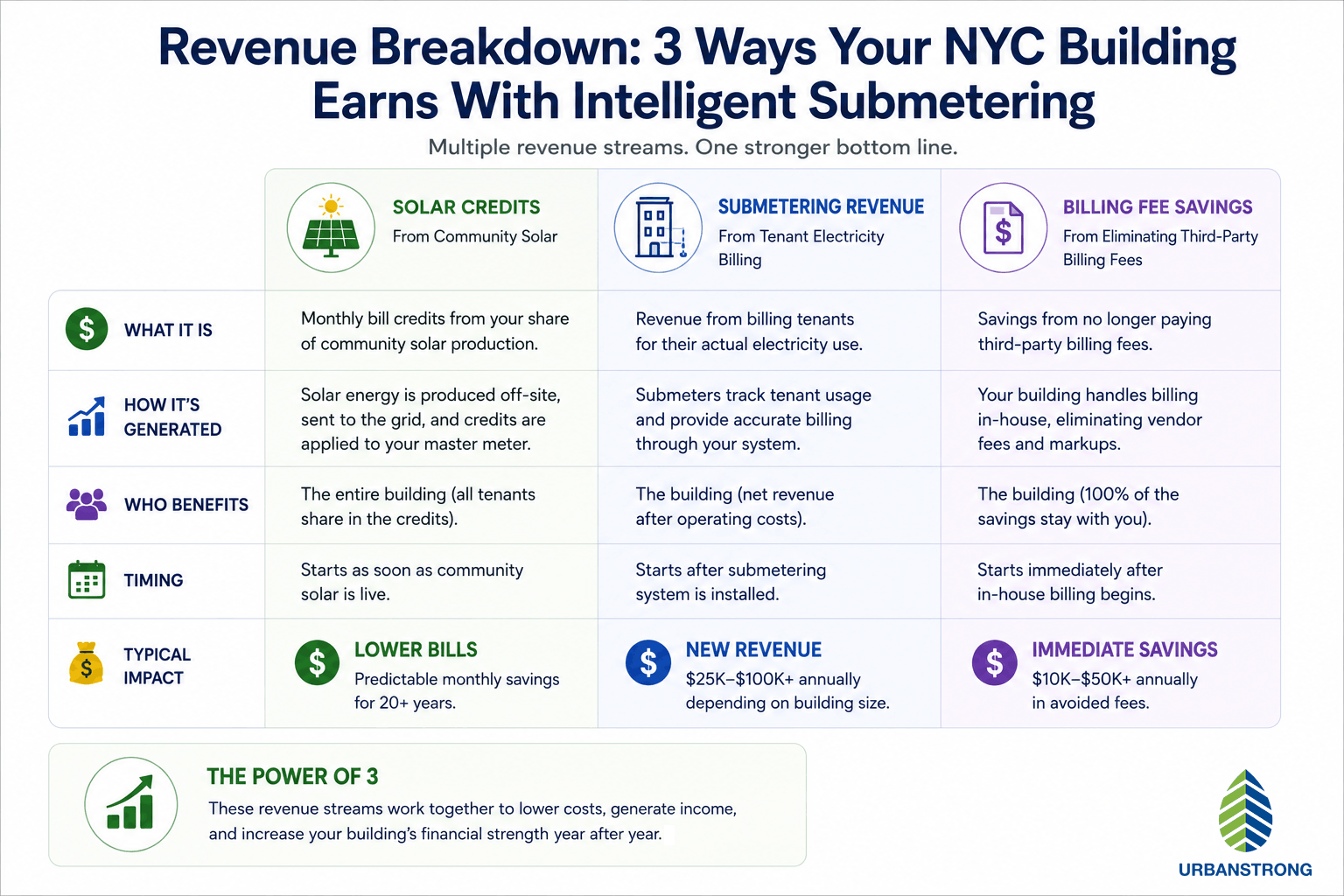
Community solar and Intelligent Submetering create multiple revenue streams for NYC co-op and multifamily buildings while lowering electricity costs.
Billing Fee Arbitrage Via Intelligent Submetering: Capturing What Con Edison Has Been Keeping
Con Edison currently charges approximately $25 per unit per month in billing and meter-reading fees. That fee has increased recently and shows no sign of declining. On an 80-unit building, that's $24,000 a year just to have meters read.
An Intelligent Submetering platform performs the same service (meter reading, billing, resident-facing account management) for roughly $7 to $10 per meter, a fraction of that cost. The spread between what residents pay in billing fees and what the building pays to service those meters is retained by the building as recurring monthly revenue.
This isn't a one-time incentive or a tax credit that phases out. It's structural, ongoing revenue that starts the moment the system goes live and compounds year after year.
Bulk Rate Purchasing With Master Metering and the Retail Spread
Under a master meter, the building purchases electricity at commercial bulk rates, which are meaningfully lower (15-20%) than the residential retail rate each individual unit was paying under direct metering. Residents continue to pay at or below their previous rate, as required by NYPSC regulations. The spread between the building's wholesale cost and the residents' retail billing is captured by the building.
“Con Edison has been your building's business partner for decades. They just never split the profits.”
The size of this spread varies by building, by season, and by consumption patterns, but across the buildings we've studied, it consistently represents a material and recurring source of revenue for the co-op or condo.
How Submetering Helps NYC Buildings Avoid LL97 Fines
Local Law 97 penalties are not theoretical. They represent a real and growing financial exposure on the balance sheet of every covered building in New York City. The buildings that will navigate this successfully are the ones that have granular, real-time data on their energy consumption: not annual estimates, not utility bill summaries, but actual load profiles across every unit and every common area system.
Intelligent Submetering provides exactly that. It gives boards and property managers the visibility to understand where energy is being consumed, when demand is spiking, and which systems are contributing most to the building's emissions profile. Solar lowers your emissions coefficient. Intelligent Submetering gives you the data to prove it, manage it, and reduce it over time.
And by replacing aging direct-meter infrastructure with a modern, monitored system, you're simultaneously de-risking your building's electrical infrastructure, replacing equipment that's approaching end-of-life with technology that flags problems before they become emergencies.
This isn't an energy efficiency upgrade. It's converting your building's infrastructure from a cost center into a revenue-generating asset.
What Solar Paired with Intelligent Submetering Looks Like in Practice: A Riverdale Co-op Case Study
Numbers on a page are one thing. A real project is another. Here's what a recent Urbanstrong engagement looked like for a co-op in Riverdale, Bronx, a building that's representative of many mid-size NYC co-ops evaluating this strategy right now.
The NYC Co-op Building Client
An 88-unit co-op spending approximately $79,000 per year collectively on electricity, plus an additional $26,000 in Con Edison billing fees. The roof was approaching the end of its useful life, and the board was already budgeting for a replacement. Local Law 97 compliance was on the horizon. The board wanted to understand whether there was a smarter way to handle all three issues at once.
The Strategy - Upgrading an Inevitable Roof Repair into a Solar PV and Intelligent Submetering Solution
Urbanstrong assessed the building and developed a combined scope: an 87 kW ballasted rooftop solar array using bifacial panels on a new white reflective roof, paired with a full master metering conversion and Intelligent Submetering across all 88 units. By bundling the roof replacement into the solar project scope, a portion of the roof cost qualified for solar incentives, significantly reducing the net outlay on a repair the building needed regardless. More on this coming soon in a dedicated article.
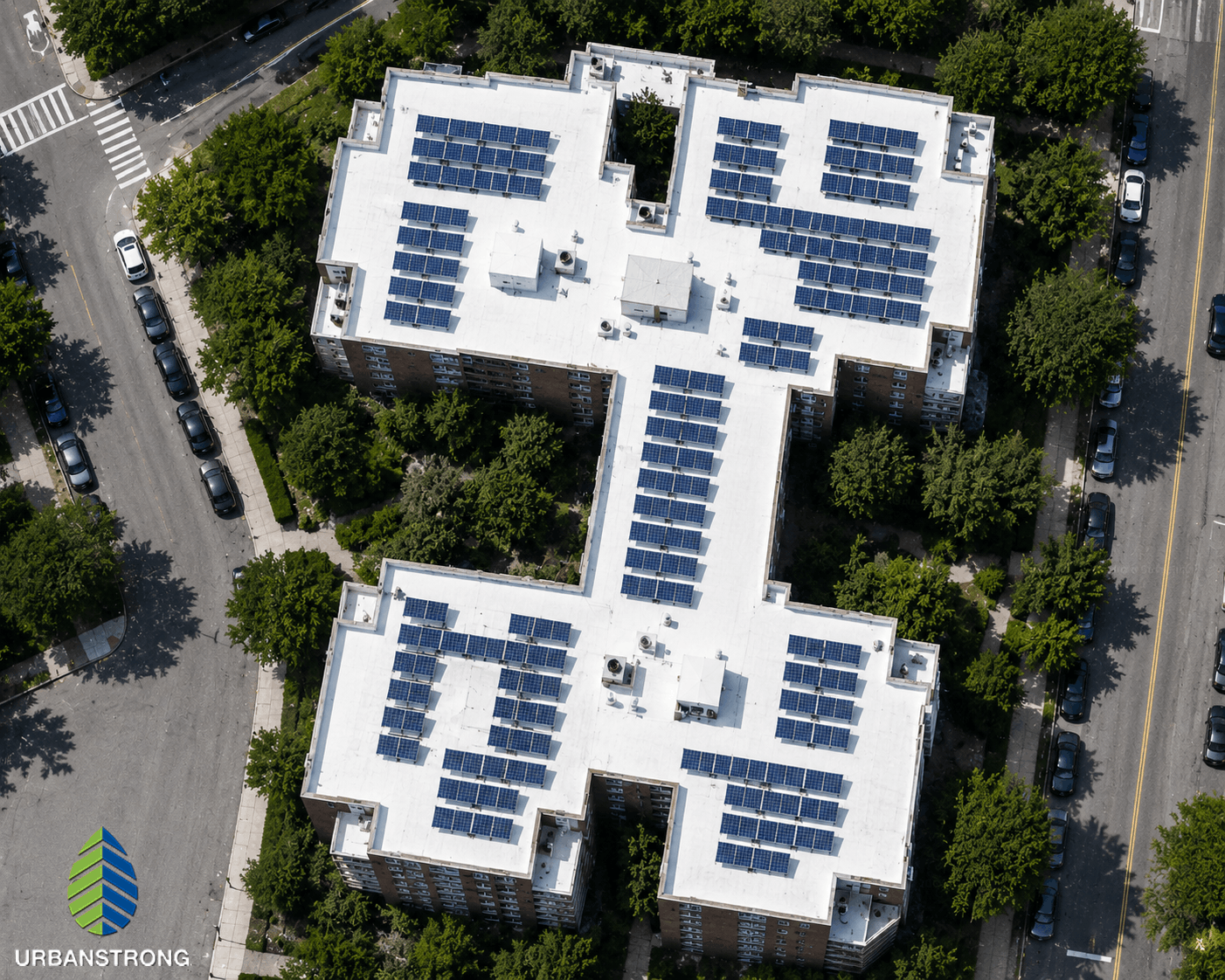
Satellite-style aerial image of a Bronx NYC co-op building where Urbanstrong coordinated rooftop solar, reflective roof replacement, and Intelligent Submetering improvements.
A Bronx Co-op Case Study: How Community Solar and Intelligent Submetering Delivered a 29% IRR
The total project cost, including solar array, submetering infrastructure, electrical room upgrades, came to approximately $367,000 after NYSERDA grants were applied. Adding in the $300,000 qualifying roof repair costs would have brought the total to $667,000 but seeing as how this was a sunk cost investment, we kept the roof repair portion out of the IRR calculations below.
Against that investment, the building's projected annual net revenue breaks down as follows:
Solar revenue (VDER community solar credits to master meter): ~$17,700/year
Net submetering revenue (billing fee arbitrage + bulk rate spread): ~$24,600/year
Combined Year 1 net revenue: ~$42,300/year
After accounting for available incentives, including the NYC property tax abatement, the NY State Renewable Energy Tax Credit, and potential federal investment tax credits for qualifying co-ops, the simple payback period came in at under four years.
The projected 25-year internal rate of return (IRR): 29%.
The projected lifetime value of the investment: $1.12 million.
And critically, $24,600 of that annual revenue (the submetering component) is structural and recurring. With Intelligent Submetering systems like this, these billing fee savings don't depend on solar production, weather, or incentive programs. They start the day the system goes live and actually grow as Con Edison rates continue to rise.
Could the J51-R Tax Abatement Offset Your Roof Repair and Submetering Costs? Here's What NYC Building Owners Need to Know
There is an additional tax abatement called the J-51 R Program which MAY apply to this project. It reduces your property tax bill over approximately eight and a half years, covering up to 70% of qualifying electrical, submetering, and roof work. However, we excluded J51 from this analysis intentionally. At the time of writing (May 2026), the program's future and administration remain uncertain and we prefer to present numbers that stand/pencil without it. If the J-51R comes through, the numbers only get better.
In fact, for buildings such as this Riverdale condo that actually qualify for both the J51-R and the federal Investment Tax Credit, there is a very real possibility that total available incentives will actually exceed the project's cash outlay. Not every Urbanstrong client building will be eligible to capture all of them (in fact very few will), and careful coordination with your CPA is essential to avoid double-dipping. But the incentive landscape for this type of project is remarkably favorable right now.
The Takeaway: Why Solar and Intelligent Submetering Stand on Their Own
Even without the roof, this project stands on its own: over $42,000 in net annual revenue, a sub-four-year payback, and a 29% IRR. But because the building also had a $300,000 roof repair on the horizon, bundling it into the same project scope unlocked incentives that would never have applied to a standalone roof job. The solar and submetering investment was worth doing regardless. The roof timing made it even better.
That's the difference between a lid and a bucket.
What Does an Intelligent Submetering System Actually Look Like?
In practice, a modern Intelligent Submetering platform operates quietly in the background of your building, continuously monitoring, measuring, and optimizing without requiring day-to-day attention from the board or property manager.
Unlike the old once-a-month manual meter reads, Intelligent Submetering captures consumption data continuously, building a detailed load profile for every unit and every common area system in the building. This data feeds into an AI-driven analytics engine that identifies consumption patterns, flags anomalies, and pinpoints opportunities to shift equipment usage to off-peak hours when electricity is cheapest.
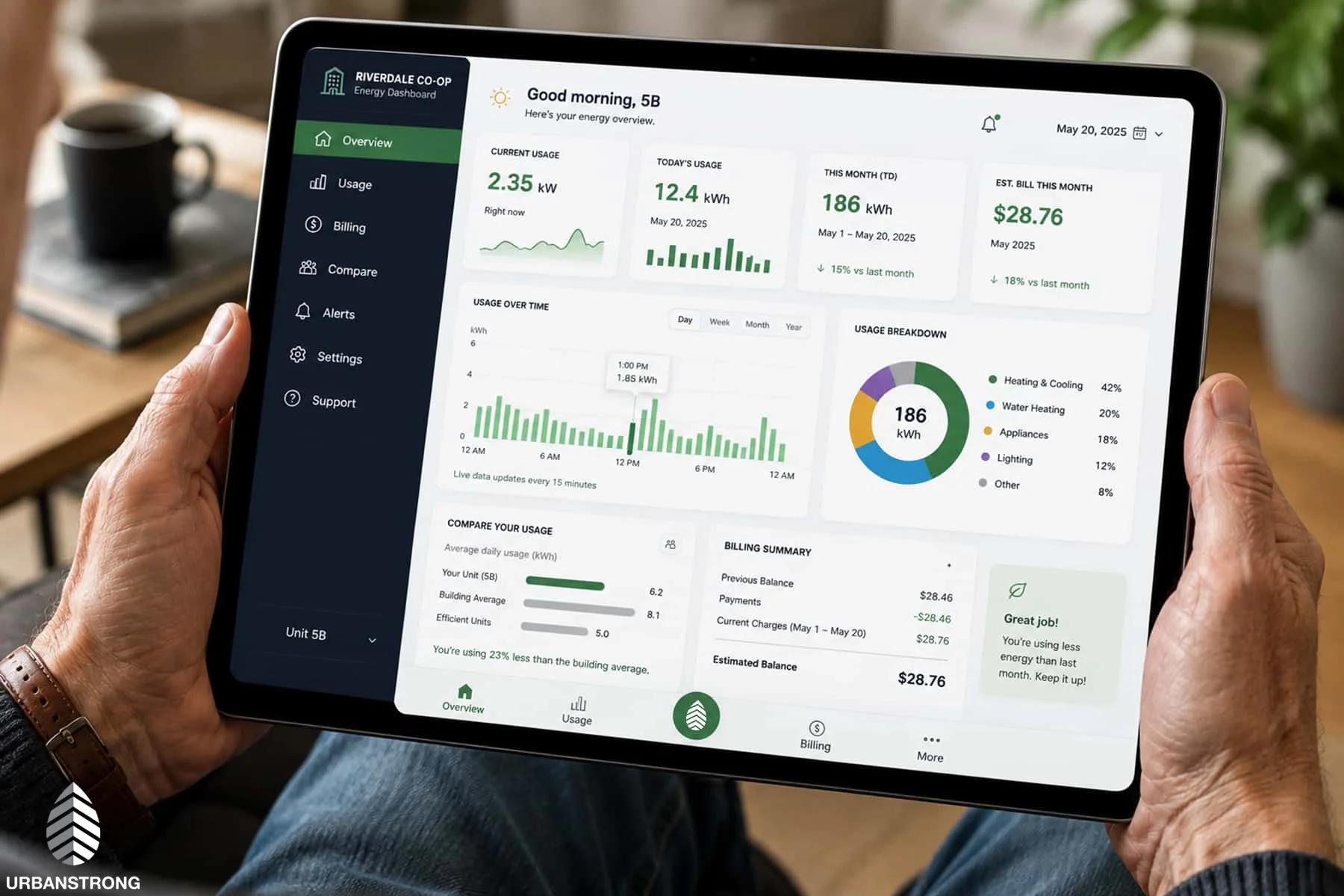
Residents can monitor real-time electricity usage, billing history, and energy trends through an Intelligent Submetering dashboard app.
Residents interact with the system through a dedicated app where they can track their daily usage, view their billing history, compare their consumption to building averages, and understand exactly what they're paying and why. This transparency is a significant upgrade from the old model, and it's one of the reasons resident satisfaction in submetered buildings tends to be high.
For the board and property management team, the platform provides a building-level dashboard with real-time visibility into total consumption, solar production, demand peaks, and billing performance. This is the kind of data that informs every future capital decision.
"Beyond Solar Credits: Other Revenue Streams Intelligent Submetering Unlocks for NYC Buildings
Rooftop solar is often the catalyst for a master metering conversion, but it's just the beginning of what Intelligent Submetering enables.
Once your building is on a master meter with real-time energy intelligence, you've built the foundation for the next generation of building electrification and energy management: domestic hot water heat pumps that run off-peak when electricity is cheapest, EV charging stations that integrate with the building's load profile, battery storage systems that capture and deploy energy strategically, and participation in Con Edison's demand response markets, where the utility actually pays you to reduce consumption during peak grid events.
We'll go deeper into each of these in future posts in this series. For now, the key takeaway is this: Intelligent Submetering isn't a one-time project. It's a platform, and every investment you make on top of it performs better because of it.
How Urbanstrong Helps NYC Co-op and Condo Boards Navigate This Process
Urbanstrong is not a solar installer. We're not a metering company. We're not selling hardware.
We are the owner's representative and strategic advisor, the firm that sits on your side of the table and helps you make financially-driven decisions about your building's energy infrastructure. We're rooftop obsessed, yes. Maximizing the potential of underutilized rooftops is where we started and it's still at the core of what we do. But the opportunities don't stop at the roof. They lead all the way down to the electrical room and everything in between: solar arrays, roof repairs, master metering conversions, submetering infrastructure, heat pumps, window replacements, and long-term energy management strategy. We help building owners uncover the hidden incentives and technologies that most boards don't know exist, and we build the roadmap to capture them.
What Working with Urbanstrong Looks Like
Every engagement starts with understanding your building. We pull your consumption data from Con Edison, assess your roof condition and solar potential, model the ROI of a master metering conversion specific to your building's unit count, tenant mix, rate structure, and capital position, and present the board with a clear financial picture before any commitments are made.
From there, depending on your needs, we can manage the entire process:
Strategic Assessment: A one-time evaluation and recommendation, ideal for boards that want clarity on whether this makes sense for their building before going further.
Advisory and Procurement: An ongoing relationship where Urbanstrong manages vendor selection, bid evaluation, and project oversight, ensuring you get the right contractors at the right price for the right scope of work.
Full Owner's Rep: Comprehensive management from initial assessment through PSC petition, installation, interconnection, and long-term performance monitoring. Urbanstrong handles it so the board and property manager don't have to.
We work alongside property managers as partners. Our role is to make their job easier, not more complicated. And we lead with strategy, not technology. The right solution for your building depends on your specific financial profile, roof condition, unit count, tenant mix, and capital position. We figure that out first. Then we build the plan around it.
Our only measure of success is whether the numbers work for you.
Is Your Building Leaving Money on the Roof?
Your roof is either a lid or a bucket. It's either keeping the rain out and nothing else, or it's capturing value, generating revenue, reducing risk, and positioning your building for the next decade of energy costs and regulatory requirements.
The difference is a decision. And the best time to make it is well before the next round of LL97 penalties, before the next Con Edison rate increase, and before the next roof repair forces the question anyway.
We understand this can feel complex. That's exactly why Urbanstrong exists.
If you're a co-op board member, condo trustee, or property manager curious about what a master metering conversion could look like for your specific building, we'd welcome a conversation. No obligation, just clarity.
In our next post, we'll cover which buildings are the strongest candidates for a master metering conversion, and what factors can make or break a project before it starts.
“The sun doesn't send an invoice. Con Edison does. Choose wisely.”
Frequently Asked Questions
-
Submetering is the practice of installing individual meters on each unit behind a single master meter to measure actual electricity consumption. The building purchases electricity in bulk from the utility at commercial rates and bills residents based on what they actually use, at no more than the retail rate they would have paid the utility directly.
-
In New York City, a building owner must petition and receive authorization from the Public Service Commission (PSC) to convert to submetering. New York State requires on-site energy generation, such as rooftop solar, as a condition for converting a directly metered building to a master meter with submetering. Once approved, the building replaces individual Con Edison meters with submeters and manages billing through an Intelligent Submetering platform.
-
Yes. Submetering is regulated by the New York Public Service Commission under 16 NYCRR Part 96. Residents are protected under the Home Energy Fair Practices Act (HEFPA) and can never be billed more than the rate they would have been charged by the utility under direct metering.
-
Generally speaking, studies consistently show that submetering reduces overall building electricity consumption by 15 to 20 percent, primarily because residents become accountable for their own usage.
Beyond consumption reduction, the building captures recurring revenue through billing fee savings. Urbanstrong’s vendors charge only $8-$10 to read meters vs the $25 that Con Edison does. This can mean tens of thousands of dollars annually for a mid-size co-op or condo. And by purchasing electricity in bulk, we’ve seen clients save a further 15 to 20 percent on electricity costs.
-
Intelligent Submetering provides real-time, granular consumption data that allows building owners to identify where energy is being wasted, optimize equipment scheduling to off-peak hours, reduce demand charges, and track emissions reductions over time. For NYC buildings subject to Local Law 97, this data is essential for understanding your building's carbon profile and demonstrating compliance. When paired with rooftop solar, submetering creates a measurable path toward both financial and environmental sustainability.
-
Local Law 97 is New York City's building emissions law that places carbon caps on most buildings larger than 25,000 square feet. Non-compliant buildings face financial penalties based on their excess emissions. Intelligent Submetering provides the granular consumption data needed to understand and manage your building's emissions profile, while rooftop solar directly reduces your building's carbon footprint.
-
Community solar is a structure where a rooftop solar array exports 100% of its electricity to the Con Edison grid rather than powering the building directly. In return, Con Edison issues bill credits to the building's master meter account based on the VDER Value Stack rate, which accounts for when and where the energy was delivered and its environmental value. For a detailed breakdown of how community solar works for NYC multifamily buildings, see our dedicated post: When Is Community Solar Much Better Than Net Metering?
-
Under New York State rules, master metered multifamily buildings with at least 10 residential units are exempt from standard community solar subscriber minimums, meaning 100% of your rooftop array's credits can be allocated to the building's master meter account.
-
Under direct metering, Con Edison owns each apartment's meter and bills every unit individually at residential retail rates. The building has no visibility into consumption patterns and no purchasing leverage. Under submetering, the building owns one master meter, purchases electricity in bulk at lower commercial rates, and uses individual submeters to bill residents based on actual usage. The building retains the spread between wholesale and retail pricing as revenue.
-
A submeter is an individual metering device installed on each unit behind the building's master meter. In an Intelligent Submetering system, these meters read consumption data continuously rather than once a month, feeding real-time information to a cloud-based platform. This platform handles automated billing, provides residents with a dashboard to track their usage, and gives the building's management team visibility into total consumption, demand peaks, and system performance.
-
The number is growing rapidly as more co-op and condo boards recognize the financial and operational advantages. However, the vast majority of NYC multifamily buildings remain on direct metering, which means most buildings are still paying Con Edison's highest retail rates and full billing fees per unit. Early adopters of Intelligent Submetering are capturing a significant financial advantage that will only grow as Con Edison rates continue to rise.
-
Timelines vary based on building size and complexity. A rooftop solar installation on a system under 50 kW can achieve Con Edison interconnection in as little as two weeks. The submetering component, which requires PSC petition and approval, typically adds several months. A realistic end-to-end timeline for a combined solar and submetering project is six to nine months.
-
The J51-R is a New York City tax abatement program that can cover up to 70% of qualifying electrical, submetering, and roof repair costs over approximately eight and a half years, paid back as a reduction in the building's property tax bill. It does not apply to solar. The program's future and administration remain uncertain as of mid-2026, but for buildings that qualify, it can significantly improve the overall return on a master metering conversion project.
About The Author
Alan Burchell is the Principal of Urbanstrong, an award-winning firm specializing in sustainable rooftop solutions. A professional engineer, LEED-AP, Fitwel Ambassador and certified Green Roof Professional, Alan holds a degree in mechanical engineering, an MBA from IESE, and a Master of Science in Sustainability Management from The Earth Institute at Columbia University, with a focus on Sustainable Water Management.
His extensive experience spans all seven continents, where he has worked as an environmentalist, project manager, speaker, and sales engineer.
For over a decade, Alan has been helping NYC co-op, condo, and multifamily building owners make smarter decisions about their rooftops and how they connect to the building's overall energy strategy. From solar arrays and green roofs to advanced stormwater management and rooftop-driven revenue strategies, his work focuses on turning underutilized building infrastructure into financially productive assets that reduce operating costs, generate new income, and position buildings for long-term regulatory compliance.

Contact Alan today at aburchell@urbanstrong.com or 215.480.2210 or book a 15-minute chat directly in his calendar here.